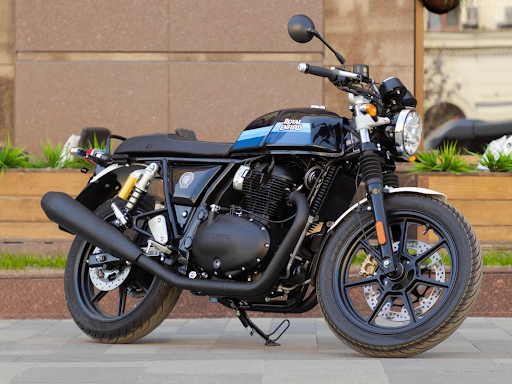
The Royal Enfield GT 650 remains a rider favourite because it delivers a focused café-racer experience without turning every journey into a high-stress performance exercise. Its 648cc parallel-twin engine has enough power to feel special, yet its delivery is progressive and usable on ordinary roads.
The most natural comparison is the Royal Enfield Interceptor , which shares the same broad engine platform but uses more upright ergonomics. That contrast explains why the GT has such a dedicated following: it deliberately chooses style and engagement over maximum practicality.
The Twin-Cylinder Engine Feels Special at Everyday Speeds
The 648cc parallel twin produces around 47.4 PS and 52.3 Nm. Unlike a high-strung supersport engine, it delivers strong mid-range torque without demanding extreme revs.
This makes the bike enjoyable even when road conditions do not allow very high speeds.
Six-Speed Gearing Supports Both Acceleration and Cruising
The six-speed gearbox gives the rider flexibility across city and highway use. Lower gears provide satisfying acceleration, while the top ratio helps the engine settle on open roads.
The gearbox is a major part of why the GT feels like a genuine middleweight rather than a larger commuter.
The Riding Position Creates the Café-Racer Experience
Low clip-ons and rear-set footpegs place the rider forward over the tank. This improves the feeling of front-end connection and gives the motorcycle its distinctive silhouette.
The same posture can become tiring in slow traffic, so the GT rewards riders who genuinely enjoy its ergonomics.
Why the Royal Enfield Interceptor Is More Practical
The Interceptor uses a higher, conventional handlebar and a more neutral foot position. That makes it easier for commuting, touring and carrying luggage.
Riders choosing the GT are knowingly trading some versatility for a stronger sporting identity.
The GT’s Design Has Aged Well
The long tank, exposed engine, round headlamp and twin exhausts are simple elements that do not depend on short-lived styling trends.
This helps the motorcycle retain visual appeal even as newer models arrive.
Current 2026 Updates Keep It Fresh
The current Continental GT 650 range introduces new colours and refreshed café-racer styling while retaining the proven engine and chassis foundation.
This evolutionary approach is sensible because the core formula remains one of the motorcycle’s strengths.
Fuel Economy Is Acceptable for the Performance
Royal Enfield quotes around 27 km/l under suitable conditions. Riders who use aggressive throttle or heavy city traffic should expect lower real-world figures.
Fuel cost is higher than on a 350cc bike, but the twin-cylinder performance is also on a different level.
The 214 kg Weight Needs Respect at Low Speed
The GT is not a lightweight motorcycle. Parking, reversing on slopes and tight U-turns require more effort than on a 150cc roadster.
Once moving, the mass contributes to a stable and planted feel.
Braking and Tyres Support the Chassis
A 320 mm front disc and 240 mm rear disc combine with ABS. Current tyres are sized for middleweight road performance.
Regular pressure checks are essential because tyre condition strongly affects handling on a motorcycle of this weight and output.
It Makes Sense as a Weekend and Occasional Daily Bike
The GT can commute, but its strengths emerge more clearly on open roads. Riders who spend every day in dense traffic may find the Interceptor easier.
Those who ride primarily for enjoyment may find the GT’s posture far more rewarding.
Customisation Adds Long-Term Appeal
Seats, mirrors, handlebars and cosmetic parts can change the motorcycle’s appearance significantly. The clean chassis gives owners a strong platform without hiding the parallel twin.
Modifications should remain legal and preserve safe lighting and braking.
Why the GT 650 Is Still a Favourite
The Royal Enfield GT 650 remains popular because it has a clear purpose. It is not trying to be the most comfortable or economical motorcycle in the range. It is trying to make every ride feel like a café-racer experience.
For riders who value that focus, the GT offers more emotional reward than the more practical Royal Enfield Interceptor. That is why it continues to inspire loyalty rather than simply compete on specifications.
Long-Term Ownership Rewards the Simple Mechanical Layout
The GT uses a relatively straightforward air-oil-cooled parallel twin rather than a highly complex electronics-heavy powertrain. This contributes to the motorcycle’s mechanical feel and makes the engine visually central to the bike.
Routine maintenance still matters, especially chain care, tyre pressure and oil changes, but the core ownership experience remains refreshingly direct.
What to Verify Before Finalising This Motorcycle
Before paying a booking amount, confirm the exact variant, current ex-showroom price, insurance, registration charges and standard equipment in your city. Manufacturers can revise prices or variant equipment, so a current dealer quotation is more useful than an old online listing.
Also test the motorcycle on realistic roads and check pillion comfort if relevant. A good purchase should remain comfortable, affordable and easy to service long after the initial excitement has faded.
Why the Engine Platform Has Enduring Appeal
The 648cc twin is central to the GT’s popularity because it offers strong performance without feeling excessively aggressive. The engine can be ridden calmly in traffic and still deliver satisfying acceleration on open roads. This broad usability helps the motorcycle appeal to both newer middleweight riders and experienced owners.
The same engine also underpins the Interceptor, which gives buyers confidence that the platform is not a low-volume experiment. Service familiarity and parts support matter over long ownership periods.
Use a Back-to-Back Interceptor Test Ride
The most useful comparison is to ride the GT and Interceptor on the same day. Engine performance is similar, so the difference in handlebar height, footpeg position and wind exposure becomes immediately obvious. That test usually reveals whether the buyer truly wants café-racer ergonomics or simply likes the GT’s appearance.
Its enduring popularity therefore comes from the way the engine, posture and styling reinforce the same focused riding character rather than competing with one another.
About The Author