Your new phone is thinner than last year’s. So why does it have a much bigger battery?
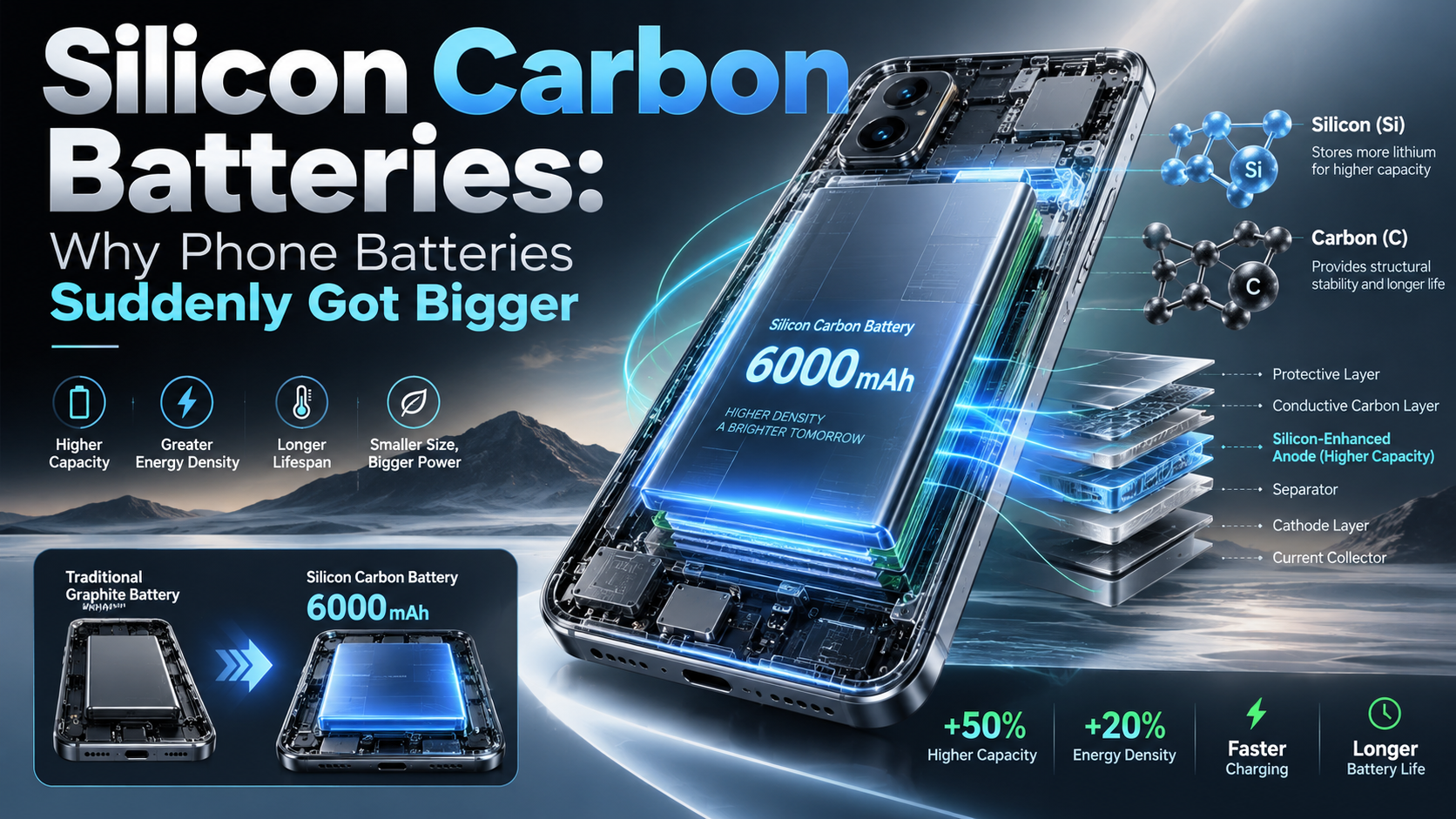
The answer is a quiet change inside the cell. Silicon carbon batteries have taken over the flagship market, and the numbers show it. The average smartphone battery hit 5,291mAh in January 2026, a jump of 400mAh in one year, which Counterpoint Research called the biggest yearly rise since December 2021.
This guide explains what changed, which phones use it, and the parts most articles skip: the downsides.
What is a silicon carbon battery?
A silicon carbon battery is still a lithium-ion battery. The difference sits in the anode, the part that holds the charge. Instead of using only graphite, makers mix in silicon, which stores far more lithium in the same space.
The result is 10 to 20% more energy in the same volume. That is why a phone can get thinner and still carry a 7,000mAh battery.
The trade-off: silicon swells when it charges, so these cells usually wear out sooner than the best graphite ones.
Why Graphite Was Holding Phones Back
For years, phone batteries barely grew. Makers were stuck between two things people want: a thin phone and long battery life.
The limit was the anode material. Graphite can hold a set amount of lithium and no more.
| Anode material | Theoretical capacity | Swelling when charging |
|---|---|---|
| Graphite | ~372 mAh per gram | About 10% |
| Pure silicon | ~4,200 mAh per gram | Up to 300% |
| Silicon carbon blend | Between the two | Around 10 to 20% |
Capacity and swelling figures from Android Authority. Engadget quotes graphite at about 330 mAh/g and puts silicon’s expansion nearer 400%, so treat these as a range, not exact physics.
Silicon holds roughly ten times more lithium than graphite. So why not build the whole anode from silicon?
Because it would destroy itself. A pure silicon anode swells so much during charging that it cracks apart within a few cycles. That is the problem carbon solves.
How Silicon Carbon Batteries Actually Work
Think of it as a sponge inside a cage.
- Silicon is the sponge. It soaks up lithium by bonding with it, not just slotting it between layers the way graphite does. That is why it holds so much more.
- Carbon is the cage. Silicon particles sit inside a porous carbon structure, which gives them room to expand without tearing the anode apart.
- The mix stays mostly graphite. One example given by researchers is 75% graphite with 25% silicon powder. Some cells use far less.
This is why the name is a little misleading. The cathode is still lithium-based. The electrolyte is unchanged. Only the anode recipe is new.
Even Tesla has used a small silicon share, around 3 to 5%, in some of its cells since at least 2016.
Silicon Carbon Batteries vs Lithium-Ion: Pros and Cons Compared
Here are the silicon carbon batteries pros and cons, side by side, without the marketing.
| Standard lithium-ion (graphite) | Silicon carbon | |
|---|---|---|
| Energy density | Baseline | 10 to 20% higher |
| Battery size in the same body | Smaller | Larger |
| Charging speed | Slower | Faster. Silicon takes lithium in more easily |
| Cycle life | Longer | Shorter in current phones |
| Heat | Lower | Slightly higher. Silicon conducts electricity less well |
| Cost to make | Lower | Higher and more complex |
| Raw material supply | Most graphite anode material is processed in China | Silicon is the most abundant metal in the Earth’s crust |
| Availability | Everywhere | Mostly flagships, led by Chinese brands |
One point to be clear about: silicon carbon is not a different battery type. It is lithium-ion with a better anode. Anyone selling it as a brand new technology is overselling it.
Which Phones Use Silicon Carbon Batteries?
HONOR was the first major brand to ship them. Xiaomi, OPPO, OnePlus and vivo followed.
Phones confirmed in reporting:
| Phone | Battery | What makes it notable |
|---|---|---|
| OnePlus 15 | 7,300mAh | Lasted 38.5 hours in Engadget’s rundown test, in a body only a millimetre or two thicker than the iPhone 17 |
| OnePlus 13 | 6,000mAh | Up from 5,400mAh in the previous model |
| Xiaomi 15 Ultra | 6,000mAh (China) | The global version used 5,400mAh |
| OPPO Find X8 Pro | 5,910mAh | Large cell in a standard flagship body |
| vivo X Fold 3 Pro | 5,700mAh | Fits a 5.2mm folding design |
| Samsung Galaxy Z Fold 8 and Fold 8 Ultra | [CONFIRM capacity] | Samsung uses silicon to shrink the battery rather than chase maximum capacity. Its product page still lists the cell as “Lithium-ion” |
A useful signal: among the ten best-selling phones with 6,000mAh or more in early 2026, six used silicon carbon. The best seller of that group, the Redmi 15C 4G, used an ordinary lithium-ion cell. So a big battery does not automatically mean silicon carbon.
Newer models listed by retailers include the OnePlus Nord 6 at 9,000mAh, the iQOO Neo 12 at 9,000mAh and the OPPO Find X10 Pro Max at 8,000mAh. These come from retail listings rather than teardowns, so confirm the chemistry on the maker’s own spec sheet before you buy.
China matters here. Counterpoint found the average battery capacity in China runs over 1,000mAh higher than the rest of the world, which is where this race started.
What Are the Disadvantages of a Silicon Carbon Battery?
This is the section that decides whether the upgrade is worth it to you.
1. Shorter cycle life. This is the main cost. EU energy labels rate Samsung’s Galaxy Z Fold 8, Fold 8 Ultra and Flip 8 at about 1,200 charging cycles before dropping to 80% capacity. Last year’s Galaxy Z Fold 7 and other flagships were rated at about 2,000 cycles. Google Pixel and iPhone models are rated around 1,000 cycles on the same measure.
One caveat worth knowing: some readers have argued the drop comes from a change in Samsung’s testing method rather than the chemistry itself. We could not confirm that either way, so treat the gap as reported, not proven.
2. More heat. Silicon conducts electricity less well than graphite. That raises internal resistance, which means more heat during heavy use and fast charging.
3. Fast charging makes it worse. Many of these phones ship with 80W to 120W charging. Heat and high current are what age a battery. The faster you charge, the sooner you will notice the capacity drop.
4. Higher cost. The cells are more expensive and more complex to make. That cost lands in the phone price.
5. Not everywhere yet. It is mostly a flagship feature, concentrated in Chinese brands. Mid-range phones will take time.
The practical read: if you keep a phone for two years, the shorter cycle life will barely matter and you get a clearly bigger battery. If you keep a phone for four or five years, a conventional cell may serve you better.
Silicon Carbon Batteries Price: What You Actually Pay
There is no separate price tag for the battery. You pay for it inside the phone, and in a pricier replacement later.
What we can say about cost with real numbers:
- At the material level, silicon is cheap. It is the most abundant metal in the Earth’s crust. OneD Battery Sciences says its silicon processing costs under $2 per kWh.
- Sila Nanotechnologies’ CTO expects silicon to become cheaper than graphite at material level once production scales.
- Manufacturing is the expensive part, not the silicon. Building cells that handle the swelling takes more precise engineering.
So the premium you pay today reflects early production, not an expensive raw material. Expect that gap to narrow.
Silicon Carbon Batteries in Cars: The Bigger Prize
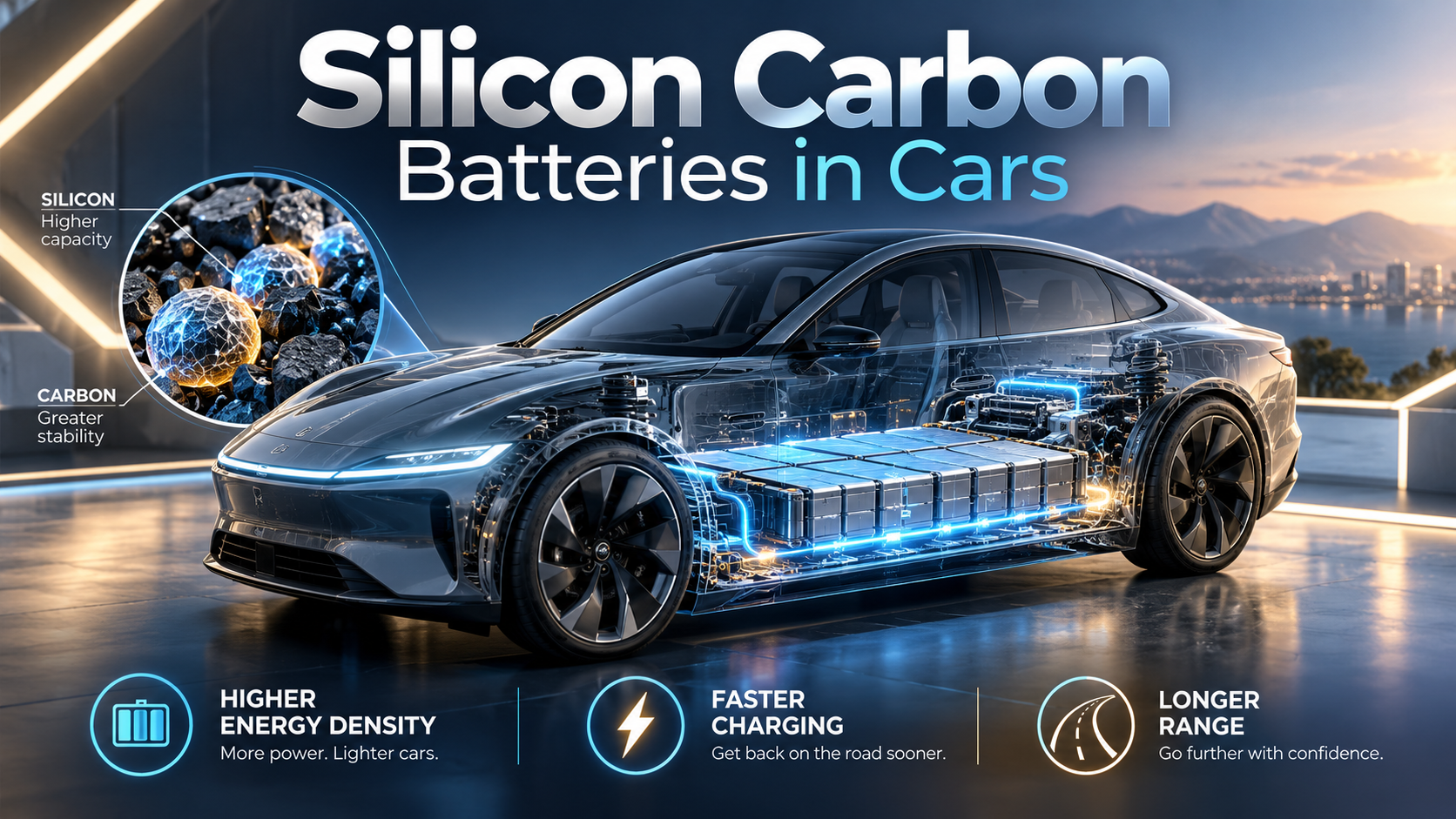
Phones are the test track. Electric vehicles are the real target, because range sells cars.
| Company | What they claim | Where it is going |
|---|---|---|
| Amprius | A certified 500 Wh/kg, roughly double today’s EV cells | Airbus and BAE Systems already use its cells in aircraft |
| Sila Nanotechnologies | About 20% more energy density, roughly 160 km more range | Slated for the Mercedes G-Class |
| OneD Battery Sciences | 350 Wh/kg | Works with General Motors on Ultium cells |
| Enevate | Around 220 km of range from a 10-minute charge | Used in Lightning Motorcycles electric bikes |
| Group14 | Amorphous silicon in porous carbon, claimed for greater cycle life | A Porsche EV, plus air taxis and eVTOLs |
| NanoGraf | About 10% higher energy density | Lighter military battery packs |
The pattern is clear: the technology proves itself in small, high-value devices first, then moves to cars.
Should You Buy a Phone With a Silicon Carbon Battery?
Here is a simple way to decide.
| You are… | Our take |
|---|---|
| Upgrading every 2 years | Yes. You get a bigger battery and will likely sell the phone before the cycle life matters |
| Keeping the phone 4+ years | Think twice. A conventional cell may hold capacity better over that span |
| A heavy user who charges twice a day | Yes, with care. The extra capacity helps most here. Use slower charging when you are not in a hurry |
| Buying mid-range | Not a deciding factor yet. Few mid-range phones use it. Judge on battery size and charging speed instead |
| Paying a big premium just for this | No. A 10 to 20% energy gain does not justify a large price jump on its own |
How to make any big battery last longer
These apply to every phone, and matter more with silicon carbon:
- Use slower charging when you have time. Save the 120W brick for when you are rushing.
- Keep the phone cool while charging. Take the case off, and do not charge it under a pillow.
- Avoid charging to 100% every time if your phone offers a charge limit setting.
- Do not leave it at 0% for days. Deep discharge is hard on any lithium cell.
What to Check Before You Buy
Specs pages can be vague, so look for these four things:
- Does the maker say “silicon carbon” on its own spec page? Retail listings are not proof. Samsung’s own page still says “Lithium-ion” even on models reported to use silicon.
- The EU energy label cycle rating, if sold in Europe. It tells you the cycles to 80% capacity.
- Charging wattage against battery size. Very high wattage on a very large cell will age it faster.
- The warranty on the battery specifically, not just the phone.
Looking for more buying guides before you upgrade? We cover the hardware decisions that actually change your day: see our guides on Wi-Fi 7 routers in India, passwordless login and passkeys, and our phone comparisons such as V60e vs Vivo V60 and OPPO A78 5G vs OPPO A3X.
[CONFIRM: add your client CTA and link here.]
Frequently Asked Questions
Are silicon carbon batteries better than lithium?
Silicon carbon batteries are lithium-ion batteries, so the real comparison is against graphite anodes. They hold 10 to 20% more energy in the same space and charge faster. In exchange, they usually last fewer charge cycles and run slightly warmer. Better for capacity, not better in every way.
What is a carbon silicon battery?
A carbon silicon battery is a lithium-ion cell whose anode mixes silicon into graphite instead of using graphite alone. Silicon holds far more lithium, so the cell stores more energy in the same volume. The carbon acts as a porous frame that gives the silicon room to swell without cracking the anode apart.
What are the disadvantages of a silicon carbon battery?
The main one is shorter cycle life. Samsung’s latest foldables are rated around 1,200 cycles to 80% capacity, against about 2,000 for the previous generation. They also run slightly warmer, because silicon conducts electricity less well, and they cost more to manufacture. Availability is still limited mostly to flagship phones.
Are silicon carbon batteries any good?
Yes, for most buyers. They are the reason phones now ship with 6,000 to 9,000mAh batteries without getting thicker, and the OnePlus 15 ran 38.5 hours in one rundown test. If you replace your phone every two or three years, the shorter cycle life will rarely become a problem you notice.
What phones use silicon carbon batteries?
HONOR adopted them first, followed by Xiaomi, OPPO, OnePlus and vivo. Reported models include the OnePlus 15 and 13, Xiaomi 15 Ultra, OPPO Find X8 Pro and vivo X Fold 3 Pro. Samsung uses silicon in the Galaxy Z Fold 8 series. Always check the maker’s own spec sheet, since retail listings can be wrong.
Do silicon carbon batteries overheat?
They run slightly warmer than graphite cells, because silicon conducts electricity less well and that raises internal resistance. This is a matter of degree, not a safety flaw, and phone makers design cooling around it. Heat builds fastest during very fast charging, so use slower charging when you are not in a hurry.
Sources
- Engadget: What is a silicon carbon battery?
- Android Authority: Silicon carbon batteries explained
- Android Authority: Average smartphone battery capacity (Counterpoint Research data)
- 9to5Google: Samsung silicon carbon battery longevity ratings
- IEEE Spectrum: Silicon anode batteries
- Smartprix: Silicon-carbon battery phones list
About The Author