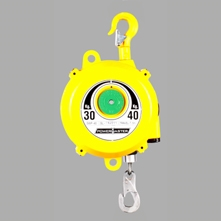
The retractable spring balancer and weighing spring balancer serve as essential tools in industrial settings that require precise operations with high productivity levels. Although the two systems depend on spring mechanisms, they operate in different ways and serve distinct purposes as well as offer unique advantages to users.
The article demonstrates how industries need to recognize the differences between these two tool types to select the appropriate equipment which matches their particular operational requirements.
What is a Retracatable Spring Balancer?
The retractable spring balancer provides an efficient solution for tool suspension which helps operators to work without fatigue while their productivity increases. The system uses a spring mechanism to balance the weight of tools such as drills and grinders and welding equipment. The balancer retracts and extends smoothly which enables operators to move tools freely within a defined range.
These devices are commonly used in assembly lines, automotive workshops, and manufacturing units. The system keeps tools suspended which decreases worker strain while protecting tools from falling hazards to create a safer work environment.
High-quality retractable balancers are built to last through harsh conditions which include features that allow users to adjust tension, including use of safety locks for protection against corrosion.
What is a Weighing Spring Balancer?
A weighing spring balancer is a measurement device used to determine the weight or force of an object. It operates based on Hooke’s Law, where the extension of a spring is proportional to the force applied. These balances are widely used in laboratories, educational settings, and light industrial applications.
These devices come in different weight capacities which require calibration to show exact weight measurements in either kilograms or newtons. The product’s basic structure combined with its ability to be moved makes it suitable for fast yet accurate weight measurement tasks.
Key Differences Between the Two
The primary difference lies in their purpose. A retractable spring balancer is a tool-support system, while a weighing spring balancer is a measuring instrument. The balancer enables better workflow by hanging tools from above while the weighing balance delivers accurate and precise weight measurements.
Another distinction is in their construction. Industrial environments require retractable balancers to maintain operational function through their durable housing system and ability to retract cables and support weight through their built-in hooks. The weighing spring balances use less weight because their design focuses on precise measurements instead of heavy industrial work.
Conclusion
Industries must evaluate their operational needs before making a choice. The nature of industrial work that requires tools to be lifted repeatedly makes retractable balancers the perfect solution. Weighing balancers better suit locations where weight and force measurement functions as the main operational task. Hence, choosing the right device will determine both operational efficiency and workplace safety.
Leading manufacturers of these products like Spring Balancers are known for offering reliable and high-performance solutions in this domain. Their industrial grade products provide reliable performance which maintains safety standards and operational efficiency across various applications.
About The Author