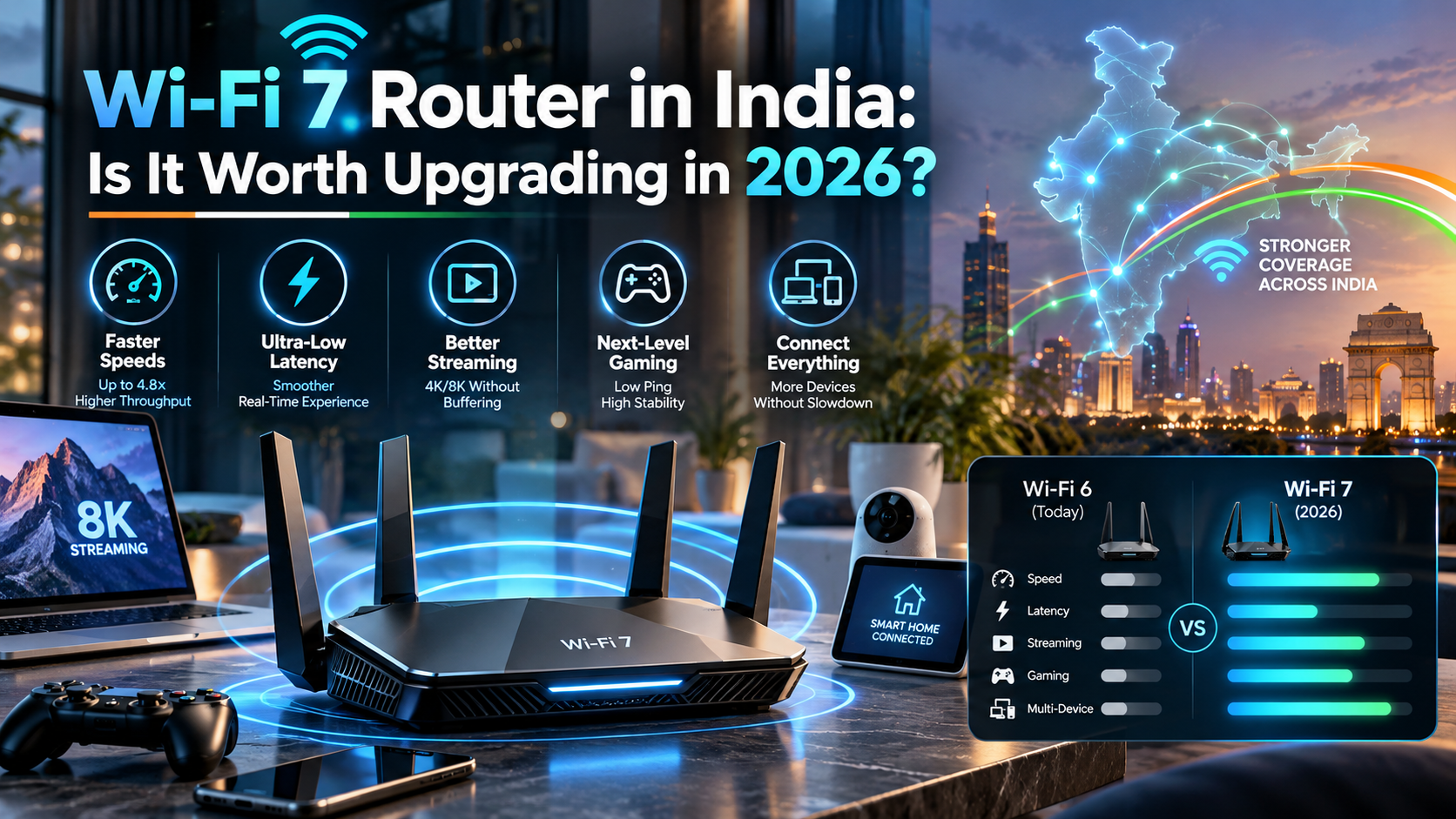
Something changed for Indian home networks this year, and most buying guides have not caught up.
On 21 January 2026, the Department of Telecommunications opened the lower 6 GHz band for licence-free Wi-Fi. Before that, many 6 GHz routers sold in India shipped with the band switched off. That one rule change is the real reason to look at a Wi-Fi 7 router in India now.
But “worth it” depends on your broadband plan, your devices and your home. This guide gives you a straight answer, with current prices and the one spec most WiFi 7 router buyers in India get wrong.
Is a Wi-Fi 7 router worth buying in India?
For most Indian homes on a 100 Mbps plan, no. Not yet. A good Wi-Fi 6 router already handles that speed with room to spare.
Wi-Fi 7 is worth it if any of these fit you:
- You have a 300 Mbps or 1 Gbps fibre plan
- You run 15 or more devices at once and Wi-Fi feels slow in the evening
- You own a recent flagship phone or laptop that supports Wi-Fi 7
- You do online gaming or video calls where a sudden lag spike matters
Skip it if: your plan is 100 Mbps or less, your devices are two or more years old, or your main problem is weak signal in one room. A mesh system or a better placement fixes that, not a new standard.
Why January 2026 Changed Things
Here is the part most guides miss.
The Department of Telecommunications issued an Extraordinary Gazette notification on 21 January 2026 that removed the licence requirement for low power and very low power wireless access systems in the 5925–6425 MHz range. That is the lower half of the 6 GHz band. The full band runs from 5.925 GHz to 7.125 GHz, so India opened roughly half of it.
What this means in plain words: you can now legally use the 6 GHz band on your home router in India, as long as the device meets the government’s technical conditions.
What it does not mean: the whole 6 GHz band is open. Only the lower half is.
The rules come with limits. Use is aimed at indoor settings. Reported restrictions include oil platforms, moving vehicles such as cars and trains, boats, drones and unmanned aerial systems. Aircraft are barred below 10,000 feet.
One practical catch: many 6 GHz capable routers already sold in India had the band disabled by default, because the rules were unclear. Manufacturers were expected to push firmware updates to switch it on. If you already own a Wi-Fi 6E or Wi-Fi 7 router, check for a firmware update before you buy anything new. You may already have the 6 GHz band sitting unused.
Sources: VoicenData, MediaNama. Check the DoT gazette notification itself for the exact technical conditions.
WiFi 7 Router vs WiFi 6: What Actually Changed
| Feature | Wi-Fi 6 / 6E | Wi-Fi 7 | Why you care |
|---|---|---|---|
| Max channel width | 160 MHz | 320 MHz (on 6 GHz) | Wider road, more traffic at once |
| Modulation | 1024-QAM (10 bits) | 4K-QAM (12 bits) | About 20% more data per signal |
| Multi-Link Operation | No | Yes | Uses two bands at the same time |
| Spatial streams | 8×8 MU-MIMO | 16×16 MU-MIMO | Serves more devices at once |
| Preamble puncturing | No | Yes | Uses a channel even if part is busy |
| Peak theoretical rate | 9.6 Gbps | 46 Gbps | A lab number, not your real speed |
Feature list from TP-Link India.
The one that matters most: MLO. Multi-Link Operation lets a device talk on two bands at once, for example 5 GHz and 6 GHz together. It can combine them for more speed, or switch instantly when one band gets busy. This is why Wi-Fi 7 feels steadier on video calls and games, even when the raw speed number does not change much.
Be careful with the big numbers. That 46 Gbps figure is a theoretical maximum across all bands with perfect conditions. No home in India will see it. TP-Link’s own page also claims Wi-Fi 7 is 4.8 times faster than Wi-Fi 6 and has 4 times lower latency, both marked as laboratory test data. Treat those as a ceiling, not a promise.
Is Wi-Fi 7 Overkill for Your Broadband Plan?
This is the question that decides it, and almost nobody asks it.
Your Wi-Fi can never be faster than the internet plan feeding it. Here is what Indian broadband actually looks like:
| Plan speed | Monthly price (Airtel Xstream, ex-GST) | Does Wi-Fi 6 handle it? | Does Wi-Fi 7 help? |
|---|---|---|---|
| 40 Mbps | ₹499 | Easily | No |
| 100 Mbps | ₹799 to ₹1,199 | Easily | Barely |
| 300 Mbps | ₹1,599 | Yes | A little, in busy homes |
| 1 Gbps | ₹3,999 | Yes, at the edge | Yes |
Plan speeds and prices from Smartprix, updated 29 May 2026. Prices exclude GST and vary by city and operator. Check your own ISP for current plans.
Smartprix calls 100 Mbps the most popular tier for Indian households in 2026. If that is your plan, a ₹20,000 router will not make your internet faster. It cannot.
So when does Wi-Fi 7 earn its price? When the problem is not speed but crowding. India’s internet subscriber base reached 1.09 billion as of 31 March 2026, and average monthly data use per wireless subscriber climbed to 25.51 GB, up 18.49% in a year, according to TRAI’s annual performance report. More devices, more streaming, more at the same time. That is where MLO and the extra 6 GHz room help, not raw plan speed.
Best WiFi 7 Router in India: What Is Actually Available
This list is smaller than you would expect, and the 6 GHz part matters.
| Router | Class | 6 GHz band | Fast ports | WiFi 7 router price (approx) |
|---|---|---|---|---|
| TP-Link Archer BE550 | BE9300 tri-band | Yes | 5× 2.5G | About ₹20,000 to ₹22,000 |
| TP-Link Archer BE400 | BE6500 dual-band | No | 2× 2.5G | Check current listing |
| TP-Link Archer BE230 | BE3600 dual-band | No | 2× 2.5G + 3× 1G | Check current listing |
| ASUS RT-BE58U | BE3600 dual-band | No | 1× 2.5G | Check current listing |
| TP-Link Archer GE400 | BE6500 dual-band | No | Not listed | Check current listing |
| ASUS TUF Gaming BE3600 | BE3600 dual-band | No | Not listed | Check current listing |
Availability and specs from Tech Centurion, 7 October 2026. Prices move weekly, so confirm on the seller’s page.
The catch nobody mentions: most affordable Wi-Fi 7 routers sold in India are dual-band only. They give you 2.4 GHz and 5 GHz, and no 6 GHz radio at all. You get Wi-Fi 7’s other features, such as 4K-QAM and MLO across two bands, but not the 320 MHz channels that need 6 GHz.
So if you want a WiFi 7 6GHz router in India, you need a tri-band model. Check the band count before you pay, because a dual-band WiFi 7 router with no 6GHz band cannot use the newly opened spectrum.
Also worth knowing: Netgear’s Wi-Fi 7 routers are not officially sold in India, per the same source. Grey-market units come without local warranty.
What About a WiFi 7 Router With a Fiber Optic Port?
Short answer: you almost certainly do not need one, and in India you will struggle to find one.
Here is why. Your fibre connection does not plug straight into a router. Your ISP installs an ONT (optical network terminal), the small box on your wall. The fibre goes into that. The ONT then gives you a normal Ethernet cable, and that is what your router uses.
A WiFi 7 router with a fiber optic port, meaning an SFP or SFP+ port, lets you skip the ONT in some setups. That is common in parts of Europe. In India, operators like Airtel, Jio and ACT supply their own ONT and manage it, so a fibre port on your router has nowhere useful to go.
What to look for instead: a 2.5 Gbps Ethernet WAN port. That is the port that matters if you are on a 1 Gbps plan, because a plain 1 Gbps port becomes the bottleneck. Every router in the table above has at least one 2.5G port.
None of the Wi-Fi 7 routers currently listed for India in our source had an SFP fibre port or a 10G LAN port.
Common Wi-Fi Problems a New Router Will Not Fix
Before you spend ₹20,000, check whether your problem is actually the router.
| The problem | What people buy | What usually fixes it |
|---|---|---|
| Weak signal in one bedroom | A faster router | A mesh node, or moving the router to the centre of the home |
| Slow only in the evening | A faster router | Changing the Wi-Fi channel, or your neighbours’ congestion |
| Buffering on one TV | A faster router | An Ethernet cable to that TV |
| Speed test shows 90 Mbps on a 100 Mbps plan | A faster router | Nothing. That is normal overhead |
| Drops during video calls | A faster router | Band steering, or MLO if you upgrade |
| Old phone still slow | A faster router | Nothing. The phone’s Wi-Fi chip is the limit |
That last row is the big one. Wi-Fi 7 speeds need Wi-Fi 7 devices on both ends. A Wi-Fi 5 phone connected to a Wi-Fi 7 router still runs at Wi-Fi 5 speed.
A Simple Way to Decide
Answer these in order. Stop at the first “no”.
- Is your plan 300 Mbps or faster? If no, stop. Upgrade your plan first.
- Do you have at least two Wi-Fi 7 devices? If no, wait 12 months.
- Is your current router more than 4 years old? If no, a firmware update and better placement may be enough.
- Do you want the 6 GHz band? If yes, buy tri-band, not dual-band.
- Is your home large or multi-floor? If yes, buy a mesh system, not a single router.
If you reached step 5 with all yes, Wi-Fi 7 is a sensible buy. If you stopped at step 1 or 2, save your money this year.
You can also browse our other technology guides for more on home networking and devices.
Frequently Asked Questions
Is it worth buying a Wi-Fi 7 router?
It depends on your plan and devices. If you have 300 Mbps or faster fibre, several Wi-Fi 7 devices and a crowded network, yes. If you are on a 100 Mbps plan with older phones and laptops, a Wi-Fi 7 router cannot make your internet faster, so a good Wi-Fi 6 router is the better buy.
Which Wi-Fi 7 router is best for home use in India?
Among routers listed for India, the TP-Link Archer BE550 is the only tri-band model in our source list, so it is the one that can use the newly opened 6 GHz band. Cheaper options like the Archer BE230 or ASUS RT-BE58U are dual-band. For large or multi-floor homes, a mesh system beats any single router.
Is Wi-Fi 7 legal in India?
Yes. Wi-Fi 7 equipment was always legal on 2.4 GHz and 5 GHz. The 6 GHz band was the open question, and the Department of Telecommunications removed the licence requirement for 5925 to 6425 MHz on 21 January 2026. Use is aimed at indoor settings, with restrictions on vehicles, drones and aircraft.
Is a Wi-Fi 7 router better than a Wi-Fi 6 router?
On paper, clearly. Wi-Fi 7 adds 320 MHz channels, 4K-QAM, 16×16 MU-MIMO and Multi-Link Operation, which lets a device use two bands at once. In a real Indian home on a 100 Mbps plan, you will barely notice. The gap shows up on fast fibre plans and in homes with many devices running together.
Does Wi-Fi 7 work with my old phone and laptop?
Yes, it stays backward compatible, so old devices still connect. But they connect at their own standard’s speed. A Wi-Fi 5 laptop on a Wi-Fi 7 router gets Wi-Fi 5 speeds. To see any Wi-Fi 7 benefit, both the router and the device must support Wi-Fi 7.
How much does a Wi-Fi 7 router cost in India?
WiFi 7 router price in India starts low for dual-band models. Entry-level dual-band Wi-Fi 7 routers start well below tri-band models, while the tri-band TP-Link Archer BE550 sits around ₹20,000 to ₹22,000 according to our source. Prices and stock change often in India, so check Amazon, Flipkart or the brand’s own store on the day you buy.
My router already says 6E or Wi-Fi 7. Do I need a new one?
Maybe not. Many 6 GHz capable routers sold in India before January 2026 shipped with the band disabled because the rules were unsettled. Manufacturers were expected to enable it through firmware updates. Open your router’s admin page, check for a firmware update, and see whether a 6 GHz network appears before you spend anything.
Sources
- VoicenData: India de-licenses 6GHz spectrum
- MediaNama: India delicenses half the 6 GHz band for Wi-Fi
- TP-Link India: Wi-Fi 7
- RTINGS: Best Wi-Fi 7 routers
- Tech Centurion: Best Wi-Fi 7 routers in India (7 Oct 2026)
- Smartprix: Airtel Wi-Fi plans 2026 (29 May 2026)
- Free Press Journal: TRAI annual performance report, FY26
About The Author