India’s advertising market has changed shape faster than most brands have adjusted their media plans. Television reach is fragmenting, print circulation is shrinking in metros, and digital CPMs have climbed steadily while attention spans have fallen.
Yet one medium has quietly expanded across every major Indian city without much noise: elevator advertising. As urban India built upward, millions of daily lift rides became available advertising inventory — and a professional lift advertising company in India turns that inventory into a targeted, measurable channel.
This article covers what the best lift advertising services in India actually include, how the formats differ, how pricing works, and how to structure a campaign properly.
What the Medium Is
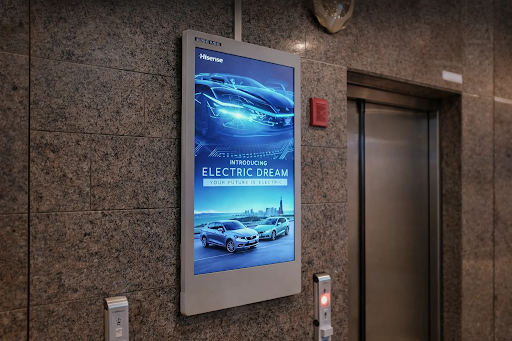
Elevator advertising places brand communication inside the lift cabins of residential complexes, office towers and commercial buildings. The standard residential format is a printed poster of roughly 13″ x 19″ mounted at eye level inside the cabin; premium and commercial buildings increasingly use digital panels.
The value comes from three things no other medium combines:
Captive attention. For 20 to 60 seconds the rider has nowhere else to look. There is no skip, no scroll, no competing signage.
Extreme frequency. A resident rides the same lift four to eight times a day. Across 30 days, that is 60 to 120 exposures per household to the same creative.
Geographic precision. You buy specific societies in specific pin codes — not a city, not a “target audience” approximation.
The Core Services a Good Agency Provides
A full-service lift advertising company in India should deliver all six of these, not just the first:
1. Inventory access and society mapping
Direct agreements with housing societies, RWAs and building management. You should receive a working list — society name, locality, towers, lifts per tower, approximate households — before you commit budget.
2. Audience and catchment planning
Matching your product to the right socio-economic profile. A premium skincare brand and a value-segment grocery app need entirely different building sets, even within the same city.
3. Creative design for the format
Lift creatives are read in seconds under poor lighting on reflective surfaces. This requires purpose-built design, not a resized social media post. The strongest agencies handle creative and execution as one connected process.
4. Production and installation
Printing, framing, mounting, and coordination with society management across multiple buildings simultaneously.
5. Verification and reporting
Dated, geo-tagged installation photographs for every location, plus periodic re-audits during the campaign. This is the single clearest marker of a professional operator.
6. Measurement support
Unique QR codes or promo codes per society cluster, campaign landing pages and dedicated contact numbers so response can be attributed and optimised.
Formats Available Across Indian Cities
| Format | Best suited to | Typical use |
|---|---|---|
| Static poster (13″x19″) | Residential societies | Mass-reach local campaigns, offers, launches |
| Backlit / framed panel | Premium residential, offices | Brand-led, high-visual categories |
| Digital screen (LCD) | Premium towers, corporate lobbies | Rotating multi-message, video creatives |
| Lift door / wall wrap | High-impact takeovers | Launches, festive campaigns, dominance buys |
| Lobby & notice board media | Add-on to lift buys | Reinforcement, longer-copy messages |
Most Indian campaigns are built on static posters because they combine the widest society availability with the lowest cost per household — with digital or wraps layered in for flagship locations.
How Pricing Works
Elevator advertising is sold per lift, per month. Your final cost is driven by:
- Volume of lifts — larger buys earn materially better per-unit rates
- Society grade — premium complexes in metro prime locations command a premium
- City tier — Mumbai, Delhi NCR and Bangalore price above Tier-2 markets
- Duration — quarterly and half-yearly commitments unlock the best rates
- Format — digital screens cost considerably more than static posters
- Production — a modest one-time cost for printing and mounting
The reason brands keep returning to the medium is efficiency. Because a single lift serves dozens of households riding multiple times daily, the effective cost per thousand impressions sits well below hoardings, print or radio in the same catchment — while delivering dwell time none of them can match.
Planning a Multi-City Campaign
If you are scaling lift advertising services India-wide, structure it in stages rather than booking everything at once:
Stage 1 — Define the catchment, not the city. List the pin codes where your stores, clinics, dealerships or delivery zones actually operate. Buy those, not “Delhi” or “Hyderabad”.
Stage 2 — Pilot in one cluster. Run 30 days across 50–150 lifts in a single locality with a unique tracking code. Establish a response baseline before scaling.
Stage 3 — Localise creative per market. Language, landmark references and offers should change by city. Localised copy consistently outperforms generic national artwork in this medium.
Stage 4 — Scale the winners. Expand into the societies and localities that produced the best cost per lead, and drop the ones that did not.
Stage 5 — Rotate monthly. Refresh creative every 30 days so daily riders continue to notice it.
Who Should Be Using Elevator Advertising
The medium performs strongly for any business with a defined local catchment: restaurants and cloud kitchens, clinics and diagnostic labs, schools and coaching institutes, gyms, salons, interior and home-improvement brands, real estate projects, banks and insurance advisors, and D2C apps pushing first-order acquisition.
It is a weaker fit for B2B enterprise sales with tiny target lists, or purely national brands with no geographic focus — although even they use it effectively for launch bursts in priority markets.
The Bottom Line
The scarcest resource in Indian advertising today is not reach. It is attention. Elevator advertising remains one of the very few environments where a brand is genuinely seen — repeatedly, in a trusted setting, by precisely the households it wants to reach.
LiftUp has been running residential elevator campaigns since 2017 across categories from national QSR chains to local service businesses. Explore how our elevator advertising model works, see the brands we have partnered with, or request a society-wise plan and quotation for your target markets.
FAQs
Q1. What is the minimum campaign duration? Thirty days is the standard minimum. Recall in this medium builds through repetition, and most brands see response strengthen from the second week onwards.
Q2. Can one campaign cover multiple cities? Yes. A single plan can span societies across several cities, with city-specific creative and separate tracking codes for each market.
Q3. How is lift advertising different from hoardings? Hoardings deliver broad, fleeting exposure with high wastage. Lift advertising delivers narrow, repeated, high-dwell exposure to a defined set of households at a fraction of the cost per contact.
Q4. Do housing societies allow advertising inside lifts? Only where a formal agreement exists with the managing committee. Reputable agencies operate exclusively on permitted, contracted inventory.
Q5. How do I measure the results? Use a unique QR or promo code per society cluster, route it to a dedicated landing page or number, and compare leads and walk-ins against your pre-campaign baseline.
About The Author