Most enterprise sites get internal linking wrong. Not because nobody thinks about it, but because everybody thinks about it the same tired way: a footer full of links, maybe a “related posts” widget, and that’s it. That’s not architecture. That’s decoration.
If you’re running a site with tens of thousands of URLs, internal linking is the foundation your indexation strategy is built on. When done correctly, Googlebot will clearly recognize which pages hold topical authority and the reasons behind it. If you get it wrong, you will end up with orphaned pages, a wasted crawl budget, and link equity accumulating in areas that do not convert.
Why Crawl Budget Matters at Scale
Small sites don’t think about crawl budgets because they don’t need to.Google indexes 200 pages with ease. At 50,000+ URLs, crawl budget becomes a real constraint — the bot allocates a finite number of requests to your domain per crawl cycle, and every low-value page it wastes time on is a page it’s not spending on your revenue-driving content.
This is where log file analysis earns its keep. Pulling server logs and cross-referencing them against your XML sitemap tells you exactly which pages Googlebot is actually crawling versus which ones it’s ignoring. Pair that with a crawl using a tool like Screaming Frog, and you’ll typically find a mess: deep pages with zero internal links pointing to them, thin category pages hoarding link equity they don’t need, and canonical tags pointing in directions nobody intended.
Solid SEO services built around enterprise-scale audits usually start exactly here — mapping crawl behavior against site architecture before touching a single link. This is precisely the kind of groundwork that agencies like Nettechnocrats specialize in, offering dedicated enterprise SEO services built around crawl audits and structural fixes for large, complex domains.
Hub-and-Spoke Architecture and Topical Authority
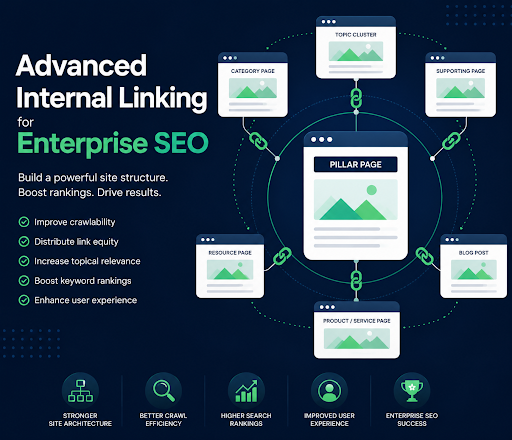
The best structure for large websites is still a hub-and-spoke model, where main pages focus on key topics and related pages cover details, all linked together in a meaningful way. This isn’t just clean UX—it’s how search engines calculate topical authority and E-E-A-T signals across a content cluster.
A lone article about internal linking is fine. A cluster of fifteen pages — covering crawl budget, canonicalization, breadcrumb navigation, and link equity distribution, all cross-linked — tells Google’s algorithm that you’re not dabbling. Rankings tend to follow topical depth, not isolated pages.
The failure mode here is treating link architecture as a one-time build. Content is published, campaigns retire, old spoke pages become orphaned—and without ongoing maintenance, that carefully built structure decays. There are nofollow tags left over from an old campaign, redirect chains that nobody cleaned up, and broken anchor targets. Six months of neglect undoes a quarter of planning.
Anchor Text and Semantic Relevance
There’s a persistent myth that anchor text needs exact-match keyword stuffing to work. This approach is unnecessary; at an enterprise scale, using exact-match keywords can appear manipulative to both users and Google’s spam detection systems. What actually moves the needle is descriptive, semantically relevant anchor text that reinforces topical relationships between pages and the same signal schema markup and structured data provided at the entity level.
“Click here” tells the crawler nothing. “Our crawl budget optimization guide” strengthens the connection between topics, and this kind of context is becoming just as important for AI-driven search results as it is for traditional ranking factors.
The Right Way to Scale Internal Linking
Enterprise sites lean on automated internal linking — nobody’s manually auditing 20,000 URLs. But automation without editorial judgment tends to generate repetitive, spammy-looking patterns: identical anchor phrases fired from every template regardless of context or link injection tools ignoring canonicalization rules entirely.
The better method combines automated website analysis and finding content gaps with a manual review of important pages — typically those that already have excellent backlinks or are close to ranking on the first page. Teams offering full-scope digital marketing services tend to treat the process as one lever among several: internal linking connected to keyword mapping, XML sitemap hygiene, and Core Web Vitals, not an isolated checkbox task. Providers delivering comprehensive enterprise SEO services increasingly pair this kind of manual review with automated crawling so large sites don’t drift back into structural decay once a campaign wraps up.
A Practical Audit Framework
Start by conducting a full site crawl and analyzing the server log files. Compare the crawl data with the log files to uncover crawl gaps and indexing issues. Identify orphaned URLs, redirect chains, and canonical conflicts. Then check your highest-authority pages using backlink data — are they linking out to pages that deserve the equity boost, or focusing it on pages that already rank?
Map your topic clusters next. Do your pillar pages exist for each core theme? Are Related pages linked back consistently or floating unlinked in the index?
Fix the biggest leaks first. A handful of strategic link additions on high-authority URLs usually outperforms a hundred scattered tweaks across low-traffic pages.
Conclusion
Internal linking at enterprise scale isn’t glamorous. But paired with clean canonicalization, disciplined crawl budget management, and consistent schema implementation, it’s one of the few technical SEO levers fully within your control — no algorithm update can strip it away, and no competitor can replicate your exact architecture.
About The Author