Introduction to AI Hardware Integration
Artificial intelligence is not about software anymore. Now it is being used in devices, which helps them make decisions faster, work automatically, and give users a better experience. AI hardware integration services help companies put intelligence into electronic hardware systems to make smart connected products. These products can look at data, learn from patterns, and respond automatically.
As companies try to find ways to be more efficient and give customers more value, putting AI into hardware products has become a big part of how products are developed. From machines in factories and medical devices to systems in stores and connected things, people are using AI-powered hardware that is changing industries all over the world.
Why AI-Powered Devices Are Changing Industries
AI-powered devices can process information right where it is, which reduces delay and makes things work better. Unlike systems that need the cloud to work, smart hardware can make decisions on its own using AI models that are built in.
This means that factories can fix machines before they break,k hospitals can keep an eye on patients, and stores can manage their inventory automatically. Delivery companies can find the best routes. As a result, companies get information faster, and things work better. It costs less to operate.
What Are AI Hardware Integration Services?
AI hardware integration services are about designing, developing, and deploying hardware systems that combine electronics, embedded software, AI algorithms, and connectivity technologies. These services make sure that AI works well in devices and meets the requirements for performance, power,r and reliability.
The goal is to turn hardware products into smart systems that can process data, recognize patterns, and work on their own.
Key Components of AI Hardware Integration
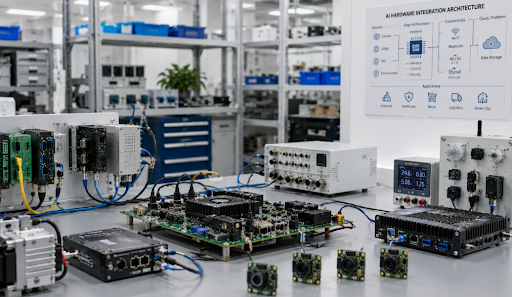
To integrate AI successfully, you need things that work together. These include AI processors, sensors, embedded firmware, communication modules, power management systems, and cloud connectivity platforms.
Engineers have to make sure that the hardware and software work together. They also have to design the circuit board, develop the embedded system, deploy the machine learning model, and test the system to make sure it works well in the world.
Core Technologies Used in AI Hardware Solutions
Modern AI hardware solutions use technologies that help make smart decisions and process data efficiently. These technologies work together to make products that can scale and respond quickly.
Sensors, Edge AI, and Embedded Systems
Sensors are the way to collect data, and they can detect things like temperature, motion, pressure, sound, and images. This data is processed using AI processors that are built into the device.
Embedded systems provide the computing power that supports AI workloads while using power. When you combine these systems with IoT connectivity technologies like Wi-Fi, Bluetooth, and LTE, you can. Operate smartly across different environments.
Benefits of AI Hardware Integration for Businesses
Companies are investing in AI hardware integration services to make their products better and get ahead of the competition. Smart devices can make things more efficient, reduce costs, and create opportunities to make money.
By putting AI into products, businesses can offer smarter features that make customers happier and make their products stand out.
Improved Automation and Operational Efficiency
AI-enabled hardware can automate tasks and reduce the need for people to get involved. For example, smart machines in factories can detect problems. Fix them automatically to keep production quality high.
Similarly connected monitoring devices can look at data all the time. Send alerts before things go wrong. This reduces downtime, makes things work better, and helps companies make decisions based on data.
AI Hardware Integration Process Explained
Making intelligent hardware products requires an approach that balances technical needs, what users want, and the limits of manufacturing.
From Concept Validation to Deployment
The process usually starts with checking if an idea is feasible and if it can work. Engineers look at what AI can do and what the market wants before choosing the hardware and processing architecture.
Next, teams make prototypes design the circuit board, create the embedded firmware, and integrate the machine learning model. After testing and optimizing, products go into pilot production. Get ready for manufacturing. Once they are validated devices are. Monitored to make sure they work consistently in the real world.
Industries Using AI Hardware Integration
More and more companies are using AI-enabled hardware to make their products and operations smarter.
Manufacturing, Healthcare, Retail, and Logistics
Manufacturing companies use AI-powered vision systems to check quality and predict when machines might break. Healthcare providers use devices to monitor patients and diagnose problems.
Retail businesses use shelves, inventory tracking systems, and customer analytics devices to make their operations better. Logistics companies use asset tracking solutions, route optimization tools, and warehouse automation systems to make their supply chains more efficient.
Challenges in AI Hardware Integration Projects
Although AI hardware integration services offer benefits, there are technical and operational challenges to overcome.
Performance, Power, and Scalability Considerations
AI needs a lot of processing power, so optimizing performance is crucial. Engineers have to balance what the computer can do with how much power it uses, especially for devices that run on batteries.
Scalability is also important. Products must be able to handle software updates, changing AI models, and more connectivity without compromising reliability or the user experience.
Importance of Edge AI in Modern Hardware Systems
Edge AI is crucial for hardware products because it allows data to be processed right on the device.
Real-Time Decision-Making at the Device LeveDoingng AI work on the device, it can make decisions without needing to connect to the cloud. This reduces delay and improves response times. Enhances privacy by sending less data.
Applications like machines, industrial monitoring systems, and smart cameras benefit a lot from edge AI because they often need to make decisions right away for safety and operations.
AI Hardware Testing and Validation Strategies
Thorough testing is necessary to ensure that intelligent hardware products work reliably in the world.
Ensuring Reliability and Long-Term Performance
Testing includes verifying the hardware, validating the firmware, checking the AI model, testing connectivity, and doing stress tests. Engineers also check manufacturing to confirm that products are made consistently and are of quality.
Choosing the AI Hardware Integration Partner
Picking the development partner is critical for success. An experienced partner can speed up development. Reduce technical risks.
Essential Factors to Evaluate
Companies should look at expertise in hardware design, embedded systems, AI, IoT connectivity, testing, and manufacturing support. Experience across industries and product categories is valuable.
Businesses should also evaluate prototyping capabilities, knowledge of regulations, quality assurance processes, and post-deployment support when choosing a partner for AI hardware integration services.
FAQs About AI Hardware Integration Services
- What are AI hardware integration services?
They combine AI technologies with hardware systems to make connected products that can make decisions on their own.
- Which industries benefit most from AI hardware integration?
Manufacturing, healthcare, retail, logistics, and other sectors use AI-enabled hardware solutions.
- Why is edge AI important in devices?
Edge AI processes data in real-time, reduces delay, uses less bandwidth, and enhances data privacy.
- What technologies are used in AI hardware products?
Technologies include AI processors, sensors, embedded systems, wireless connectivity modules, and machine learning frameworks.
- How long does AI hardware product development take?
It varies depending on the complexity features and manufacturing readiness. It can take several months to over a year.
Conclusion
AI hardware integration services are making the generation of connected products by combining intelligent software with advanced electronics and embedded systems. From edge AI processing andIoT connectivityy, to testing and manufacturing readiness, successful integration requires expertise in many areas of engineering. For companies, investing in hardware solutions can lead to automation, improved efficiency, and products that stand out and deliver real value in a connected world.
About The Author