In today’s digital era, organizations are increasingly adopting automated technologies to improve efficiency, accuracy, and security. One such innovation is the Biometric Attendance System, which has transformed the traditional methods of recording attendance. Conventional attendance systems such as manual registers, punch cards, and ID cards are time-consuming and prone to errors, manipulation, and proxy attendance. To overcome these limitations, biometric technology offers a reliable and tamper-proof solution.
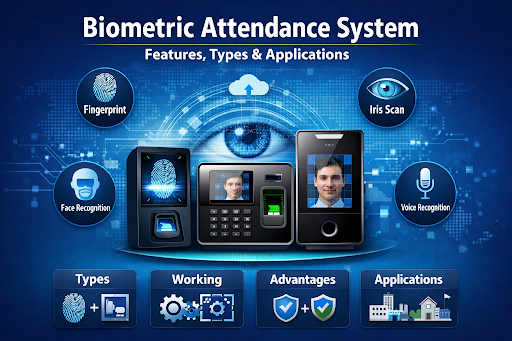
A biometric attendance system identifies individuals based on their unique biological or behavioral characteristics, such as fingerprints, facial features, iris patterns, voice recognition, or palm prints. Since biometric traits are unique to each person, the system ensures accurate identification and prevents fraudulent attendance marking. This technology is now widely used in schools, colleges, corporate offices, hospitals, factories, government institutions, and even remote workplaces.
What is a Biometric Attendance System?
A Biometric Attendance System is an automated system that records an individual’s attendance using biometric authentication. Instead of relying on cards, passwords, or signatures, the system verifies a person’s identity by scanning their biometric data and matching it with pre-stored templates in a database.
The system typically consists of:
- A biometric sensor (fingerprint scanner, camera, iris scanner, etc.)
- A processing unit
- A database for storing biometric templates
- Attendance management software
When a user places their finger on the scanner or looks into the camera, the system captures biometric data, compares it with stored records, and marks attendance instantly if a match is found.
Working Principle of Biometric Attendance System
The biometric attendance system operates in two main stages:
1. Enrollment Stage
During enrollment, the biometric characteristics of users are captured and stored in the system database. For example, fingerprint patterns or facial features are converted into digital templates using algorithms.
2. Authentication Stage
When a user attempts to mark attendance:
- The biometric sensor captures the live sample.
- The system extracts key features.
- The extracted data is compared with stored templates.
- If a match is found, attendance is recorded automatically.
This process takes only a few seconds and ensures high accuracy.
Features of the Biometric Attendance System
1. High Accuracy
Biometric systems provide precise identification since biometric traits are unique and cannot be duplicated easily.
2. Elimination of Proxy Attendance
Unlike traditional systems, biometric attendance prevents “buddy punching” or proxy attendance because no one can replicate another person’s biometric identity.
3. Automated Record Management
Attendance data is stored digitally and can be accessed anytime, reducing paperwork and manual effort.
4. Real-Time Monitoring
Administrators can monitor attendance in real time through dashboards and reports.
5. Integration with Payroll Systems
Many biometric systems integrate seamlessly with HR and payroll software, enabling automatic calculation of working hours, overtime, and leaves.
6. Fast Processing
Authentication usually takes less than one second, making it suitable for large organizations.
7. Enhanced Security
Biometric data ensures that only authorized individuals can access the system or premises.
8. Cloud Connectivity
Modern biometric systems support cloud storage, allowing remote access and centralized data management.
9. Scalability
The system can be expanded easily by adding more users or devices.
10. Audit and Reporting Tools
Attendance summaries, monthly reports, and logs can be generated automatically.
Types of Biometric Attendance Systems
Biometric attendance systems are classified based on the type of biometric trait used.
1. Fingerprint Recognition System
This is the most widely used biometric attendance system.
How it works:
- Scans fingerprint ridges and valleys
- Converts patterns into digital templates
- Matches them with stored data
Advantages:
- Cost-effective
- High accuracy
- Easy to implement
Limitations:
- May not work well with dirty or damaged fingers
- Physical contact may raise hygiene concerns
2. Facial Recognition System
Facial recognition systems use cameras to analyze facial features such as eyes, nose, jawline, and facial geometry.
Advantages:
- Contactless authentication
- Suitable for hygiene-sensitive environments
- Can work from a distance
Limitations:
- Affected by lighting conditions
- May struggle with masks or extreme facial changes
3. Iris Recognition System
Iris recognition uses unique patterns in the colored ring around the pupil.
Advantages:
- Extremely accurate
- Difficult to forge
- Stable over time
Limitations:
- High cost
- Requires specialized hardware
4. Retina Scan System
This method scans blood vessel patterns in the retina.
Advantages:
- Very high security
- Nearly impossible to duplicate
Limitations:
- Expensive
- User discomfort due to close scanning
5. Voice Recognition System
Voice recognition analyzes pitch, tone, and speech patterns.
Advantages:
- Hands-free operation
- Useful for remote attendance
Limitations:
- Affected by background noise
- Voice changes due to illness
6. Palm Vein Recognition System
Uses infrared light to detect vein patterns beneath the skin.
Advantages:
- Highly secure
- Contactless
- Works even with dirty hands
Limitations:
- High installation cost
- Limited availability
Applications of the Biometric Attendance System
1. Educational Institutions
Schools, colleges, and universities use biometric attendance to:
- Track student and staff attendance
- Reduce manual record keeping
- Improve punctuality
- Generate academic attendance reports
2. Corporate Offices
In organizations, biometric attendance helps:
- Monitor employee working hours
- Automate payroll processing
- Reduce time theft
- Improve productivity
3. Government Organizations
Government offices adopt biometric systems for:
- Transparent workforce management
- Preventing impersonation
- Ensuring accountability
4. Healthcare Sector
Hospitals and clinics use biometric attendance to:
- Track medical staff shifts
- Control access to sensitive areas
- Maintain accurate duty schedules
5. Manufacturing and Industrial Units
Factories implement biometric systems to:
- Monitor worker entry and exit
- Manage shift rotations
- Improve safety and compliance
6. Airports and Transportation Systems
Used to manage:
- Staff attendance
- Secure zone access
- Passenger identification
7. Banking and Financial Institutions
Biometric attendance ensures:
- Secure employee authentication
- Restricted access to vaults and servers
- Accurate time tracking
8. Remote and Hybrid Workplaces
With cloud-based biometric systems:
- Employees can mark attendance remotely
- Facial recognition via mobile apps is used
- Geo-fencing ensures location authenticity
Advantages of a Biometric Attendance System
- Eliminates attendance fraud
- Saves administrative time
- Improves accuracy
- Enhances organizational discipline
- Provides real-time insights
- Reduces operational costs in the long run
Disadvantages of the Biometric Attendance System
- High initial setup cost
- Privacy and data security concerns
- System failure due to power or network issues
- Accuracy can be affected by environmental conditions
Future Scope of Biometric Attendance Systems
With advancements in artificial intelligence, machine learning, and IoT, biometric attendance systems are evolving rapidly. Future developments include:
- AI-based facial recognition with mask detection
- Mobile biometric authentication
- Blockchain-secured biometric databases
- Multimodal biometrics combining face, fingerprint, and iris
- Integration with smart building systems
These innovations will make biometric attendance systems more accurate, secure, and adaptable.
Conclusion
The Biometric Attendance System has emerged as a powerful technological solution for modern attendance management. By utilizing unique human biological characteristics, it ensures accuracy, transparency, and efficiency far beyond traditional methods. With applications spanning education, corporate, healthcare, government, and industrial sectors, biometric systems play a vital role in workforce management and security.
Although challenges such as privacy concerns and installation costs exist, continuous technological advancements are addressing these limitations. As organizations move toward digital transformation, biometric attendance systems are expected to become an essential component of smart and secure infrastructure.
About The Author