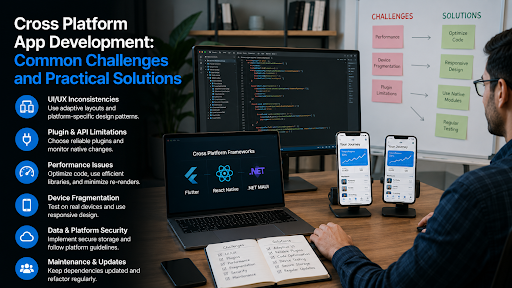
A product lead I worked with briefly had a strong opinion about cross-platform development going in: it was a shortcut, real apps were built native, and anyone pitching a shared codebase was optimizing for developer convenience at the expense of user experience. He’d come to that opinion the hard way — a previous cross-platform project that had shipped something slow, visually inconsistent, and full of platform-specific bugs that took months to untangle.
Six months into a new project with a more experienced Cross Platform App Development Company, he’d revised his opinion substantially. Same technology category. Completely different outcome. The difference wasn’t the framework. It was whether the team actually understood the challenges the approach creates and had real solutions for them, or was treating shared codebase development as native development with less work involved.
That distinction matters more than any framework comparison. Here’s what the real challenges are, and what actually addresses them.
Challenge One: Platform Behavior That Doesn’t Unify Cleanly
The promise of cross-platform development is write once, run everywhere. The reality is write once, run almost everywhere, with a handful of platform-specific behaviors that need individual attention regardless of how clean the shared codebase is.
Navigation patterns are the most visible example. iOS users have years of muscle memory built around gestures and conventions that Android users don’t share, and vice versa. A back navigation that feels natural on Android feels wrong on iOS. A modal presentation that matches iOS conventions looks out of place on Android. Neither platform is wrong — they’ve just developed different conventions that users have internalized deeply enough to notice violations without necessarily being able to articulate them.
The practical solution isn’t to ignore this or to build separate UIs for each platform. It’s to design navigation and interaction patterns with platform variance explicitly in mind from the start, using the framework’s platform detection capabilities to apply platform-appropriate conventions to shared components rather than forcing one platform’s conventions onto both. This takes more design thinking upfront than picking one convention and applying it everywhere, but it’s what produces an app that feels right on both platforms rather than native on one and slightly foreign on the other.
Challenge Two: Performance Gaps That Emerge Under Real Conditions
Cross-platform frameworks have closed the performance gap with native development significantly over the past few years. Closed it, not eliminated it. Under certain conditions — complex animations, real-time data processing, camera-intensive features, large list rendering with complex cells — performance differences can still surface in ways users feel as lag or jank.
These gaps almost never appear in development environments, where devices are recent, datasets are small, and the testing scenario is controlled. They appear in production, on older or lower-spec devices, with real data volumes and real usage patterns.
The solution has two parts. First, performance profiling needs to happen on representative hardware, not just developer machines or recent flagships. For apps targeting markets where older mid-range devices are common, this means explicitly including those devices in the testing matrix rather than assuming flagship performance generalizes. Second, performance-critical sections of the app — animations, list rendering, camera processing — are candidates for platform-specific implementations rather than shared code. Most cross-platform frameworks provide mechanisms for dropping to native code for specific components while keeping the rest of the codebase shared. Using this selectively for genuinely performance-critical paths produces better outcomes than either ignoring performance or abandoning the shared codebase entirely.
Challenge Three: Third-Party Library Gaps
The native ecosystems for both major platforms have extensive, mature library ecosystems built up over more than a decade. Cross-platform ecosystems, while substantially grown, don’t match that depth in every category.
This becomes a practical problem when a project requires functionality where the cross-platform library options are immature, poorly maintained, or simply absent. Map integrations with advanced customization, specialized hardware interfaces, certain camera capabilities, platform-specific payment flows — these are areas where the available cross-platform solutions occasionally fall short of what a native library would provide.
The practical approach is front-loading library research during discovery rather than discovering gaps mid-build. For any significant feature, understanding what cross-platform library options exist, how actively they’re maintained, and what their known limitations are before committing to the implementation approach avoids the expensive mid-project discovery that a critical feature requires either a native implementation or a significant compromise in functionality.
Top 5 Cross-Platform Frameworks for Mobile App Development
Framework choice shapes how these challenges manifest and what options exist for addressing them. Five frameworks dominate serious production use in 2026, each with a distinct profile.
Flutter renders its own UI components rather than translating to native components, which gives it precise visual control and strong animation performance, but means platform-specific UI conventions require explicit implementation rather than automatic inheritance. Strong for apps where visual consistency and animation matter most.
React Native uses a bridge to native components, which means platform conventions get inherited more naturally but introduces bridge overhead that can affect performance in demanding scenarios. The ecosystem is extremely deep given its age and adoption, which addresses the library gap problem better than most alternatives.
Kotlin Multiplatform takes a different approach — sharing business logic while keeping UI native. More development overhead than a fully shared UI framework, but produces the most genuinely native experience on both platforms because the UI actually is native. Worth the overhead for projects where platform fidelity is the primary constraint.
Ionic targets web developers building mobile apps through web technologies wrapped in a native shell. Fastest path to mobile for teams with strong web development backgrounds, with trade-offs in performance and native feel that matter more for some app types than others.
Xamarin / .NET MAUI is the enterprise-facing option, particularly relevant for organizations already deep in Microsoft’s ecosystem. Strong tooling integration with enterprise development environments, slower framework evolution than the others.
No single framework is right for every project. The choice should follow from what the app needs to do well, not from team familiarity or current industry trend.
Challenge Four: Testing Complexity That Compounds
Testing a cross-platform app is not the same as testing one app — it’s testing one codebase that produces two distinct artifacts running on two distinct platforms with genuinely different behaviors in edge cases. Teams that treat it as testing one app tend to discover the platform-specific failures in production.
A real cross-platform testing strategy distinguishes between what can be tested at the shared codebase level and what requires platform-specific validation. Business logic, data handling, API interactions — these can be tested once against the shared implementation. Navigation behavior, platform-specific UI conventions, hardware interactions, performance on platform-specific device profiles — these need explicit testing on each platform.
Automation helps significantly for the shared layer. Platform-specific testing benefits more from structured manual testing with clearly defined device profiles representing the actual hardware range the app will run on, because automated test coverage of platform-specific behavior is harder to build and maintain than most teams estimate going in.
Challenge Five: Keeping Up With Platform Evolution
Both major mobile platforms release significant updates annually, and cross-platform frameworks lag those updates by varying amounts. A new iOS capability or a new Android API doesn’t automatically become available in Flutter or React Native the day it ships — it becomes available when the framework maintainers implement support for it, which can be weeks to months later.
For most apps, this lag is inconsequential. For apps where staying current with platform capabilities is a competitive priority — using the latest camera APIs, implementing new authentication methods as they ship, supporting new device form factors promptly — the lag can create friction with how quickly the app can actually adopt what the platform makes available.
The practical mitigation is monitoring framework release notes actively rather than reactively, and building the native bridge capability to implement platform-specific features outside the shared layer when the framework hasn’t yet caught up. This requires a development team comfortable working at both the cross-platform and native layer, which is a higher skill bar than purely cross-platform development, but it’s the bar that actually lets a cross-platform app stay current with platform evolution without waiting for framework support to catch up.
What the Product Lead Eventually Understood
His earlier bad experience wasn’t a cross-platform story. It was a team competence story that happened to involve cross-platform technology. The framework didn’t cause the slow performance, the visual inconsistencies, or the platform-specific bugs — the team’s failure to address the predictable challenges of cross-platform development caused those things.
The challenges described here aren’t reasons to avoid cross-platform development. They’re the known terrain that any team working in this space needs to navigate with intention. Teams that know the challenges and have developed real solutions for them consistently produce apps that feel genuinely good on both platforms. Teams that treat the shared codebase as a reason to think less carefully about platform-specific behavior tend to produce the kind of experience that gives cross-platform development its bad reputation.
The framework is almost never the variable that matters most. The team’s understanding of what the approach actually requires is.
About The Author