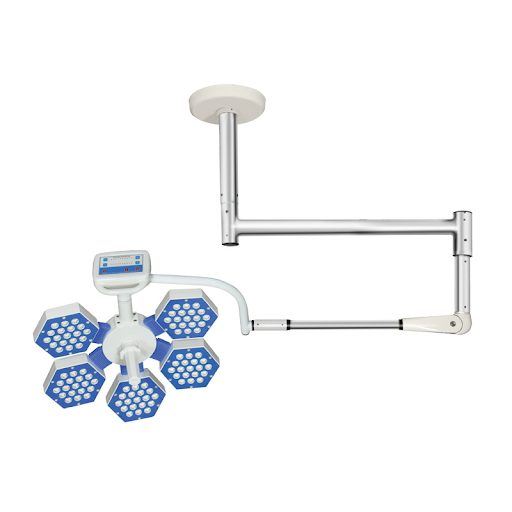
Introduction: A Decision That Affects Every Surgery
For hospitals planning to equip or upgrade their operation theatres, the choice between LED and halogen surgical lights is one of the most consequential procurement decisions they will make. It affects surgical outcomes, energy costs, maintenance budgets, and the long-term reliability of one of the most critical pieces of equipment in a hospital.
This article provides a detailed, practical comparison of LED surgical lights and halogen OT lights across every parameter that matters to hospital administrators, biomedical departments, and surgical teams.
Technology Overview: How They Work
Halogen OT lights use a tungsten filament enclosed in a halogen gas-filled bulb. When electricity passes through the filament, it produces intense white light. The halogen gas allows the filament to operate at higher temperatures without degrading as quickly as standard incandescent bulbs.
LED surgical lights use an array of Light Emitting Diodes — semiconductors that emit light when current flows through them. Unlike halogen, LEDs generate light through electroluminescence, a process that is far more energy-efficient and produces significantly less heat as a byproduct.
Lux Output and Illumination Quality
Both LED and halogen OT lights can achieve high lux output, but LED has clear advantages in how that output is delivered:
- Halogen lights provide high lux but output decreases over time as the filament degrades
- LED surgical lights maintain consistent lux output throughout their operational lifespan
- LED systems allow precise digital control of lux intensity, whereas halogen typically uses dimmer systems that can affect colour temperature
- Multi-array LED configurations achieve more uniform field illumination compared to single-source halogen setups
Colour Rendering and Tissue Visibility
This is where the difference between LED and halogen becomes most clinically significant.
Halogen lights have a CRI of approximately 95 to 100, which is excellent — this was the reason halogen remained the preferred choice for so long. However, the colour spectrum of halogen light is shifted toward the red and yellow end, which can cause subtle distortions in how tissue appears.
Modern LED surgical lights achieve CRI values of 95 and above while offering a more balanced spectral output. Some LED OT lights also include the ability to adjust the spectral composition to enhance visibility of specific tissue types. This is a capability that halogen fundamentally cannot offer.
Heat Generation at the Surgical Field
Heat management is one of the clearest differentiators between the two technologies:
- Halogen OT lights can raise the temperature at the surgical field by 5 to 10 degrees Celsius, causing discomfort for patients and potentially affecting exposed tissue during long procedures
- LED surgical lights generate minimal infrared radiation, keeping the surgical field temperature increase to less than 1 degree Celsius in most configurations
- Surgeons performing procedures lasting 4 to 8 hours report significantly reduced fatigue when working under LED lights compared to halogen
- For neonatal and paediatric surgeries, heat management is particularly critical — LED is the standard of care
Energy Consumption and Running Costs
The financial case for LED over halogen is compelling:
- A typical dual-dome halogen OT light system consumes 1,000 to 1,500 watts
- An equivalent LED dual-dome OT light system consumes 200 to 400 watts
- For a hospital running 8 operation theatres for 12 hours a day, 300 days a year, the energy savings from LED over halogen can amount to lakhs of rupees annually
- Many state electricity boards and government schemes offer energy efficiency incentives for LED adoption in healthcare facilities
When evaluating the total cost of ownership, hospitals that upgrade to LED surgical OT lights typically recover the additional initial investment within 18 to 36 months through energy savings alone.
Lifespan and Maintenance
The maintenance burden of halogen vs LED is dramatically different:
- Halogen bulbs have a rated lifespan of 2,000 to 5,000 hours and require regular replacement
- LED surgical lights have a rated lifespan of 50,000 hours or more — equivalent to over 10 years of regular use
- Halogen bulb replacement requires trained biomedical technicians and strict handling procedures to avoid premature failure
- LED lights typically have no user-replaceable components during their operational lifespan, dramatically reducing maintenance requirements
- Spare parts availability for halogen systems is increasingly becoming an issue as manufacturers phase out halogen product lines globally
Installation and Infrastructure Requirements
LED surgical lights are generally lighter than equivalent halogen systems, reducing the structural load on ceiling mounting systems. For hospitals constructing new operation theatres, this can simplify ceiling reinforcement requirements.
For hospitals upgrading from halogen to LED, most ceiling mounting points are compatible with LED systems, though it is advisable to have a technical assessment done before procurement to confirm compatibility.
Smart Technology Integration
This is exclusively a feature of modern LED surgical lights. No halogen OT light offers:
- Digital touch panel controls with programmable memory settings
- Wireless connectivity for remote monitoring and control
- Integration with hospital IoT platforms
- Built-in camera systems for surgical recording and telemedicine
- Usage hour tracking for predictive maintenance scheduling
These smart capabilities, now available from Indian OT light manufacturers like Ventek India, make LED the clear choice for hospitals building technology-forward operation theatres.
Verdict: LED is the Clear Choice for New and Upgraded OT Setups
The evidence across every parameter — clinical performance, energy efficiency, lifespan, maintenance requirements, and smart technology integration — points decisively to LED as the superior choice for any hospital investing in surgical lighting today.
Halogen may still have a role in very cost-constrained environments or legacy installations where immediate upgrade is not feasible, but for any new OT setup or planned equipment upgrade, LED surgical lights represent the best investment a hospital can make in its operation theatre infrastructure.
Explore the full range of LED-based shadowless OT lights from Ventek India — a certified Indian manufacturer with 18+ years of experience and 30,000+ installations across India and globally.
About The Author